Name:_______________________
Economics 637 Final
Prof. Bryan Caplan
Spring, 1998
Instructions:
Part 1: True, False, and Explain
(10 points each - 3 for the right answer, and 7 for the explanation)
State whether each of the following twelve propositions is true or false. Using 2-3 sentences AND/OR equations, explain your answer.
1. True, False, and Explain: If a regression of Y on X (without a constant) yields: Y=3X, then a regression of X on Y necessarily yields X=(1/3)Y.
2. Suppose that in reality, a person's income I=$20,000+$200*IQ+$500*PIQ, where PIQ is a measure of a person's "practical intelligence." PIQ tries to measure "practical" cognitive abilities not captured in IQ tests.
True, False, and Explain:
If an econometric researcher unfamiliar with PIQ uses OLS to estimate I=a+b*IQ, it is possible that he will still find that b=$200.
3. A multiple regression of income (in $'s) on years of education and years spent in prison yields:
I=15,000+1000*Education-1500*Prison
The variance-covariance matrix of the coefficients is:
|
Education |
Prison |
|
|
Education |
40,000 |
-50,000 |
|
Prison |
-50,000 |
90,000 |
True, False, and Explain:
You can reject the hypothesis (at the 5% level) that the summed effect on your earnings of doing prison time AND attending the prison school is zero.
4. OLS on the following data yields:
|
Y |
X |
Yi=1.500 + .700*Xi (.245) (.100) R2=.942 |
|
4 |
3 |
|
|
4 |
4 |
|
|
3 |
2 |
|
|
2 |
1 |
|
|
1.5 |
0 |
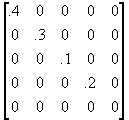
True, False, and Explain: The matrix s 2W (used to calculate the HCSE's) can be estimated to be:
5. If the correlation between et and et-1 is -.3, then the DW statistic will approximately equal 3.4.
6. True, False, and Explain: The following ARMA process for Yt is difference stationary: (1-L)Yt=(1-L-L2)e t. (e t is iid).
7. Consider the VAR: Yt=AYt-1+e
t, where Yt=[GDPt Mt]' and A= .
.
True, False, and Explain: The impulse-response function for the impulse
e 0=[0 1]' looks like:
|
t |
GDPt |
Mt |
|
0 |
0 |
1 |
|
1 |
.5 |
.9 |
|
2 |
.3 |
.4 |
Questions 8 and 9 refer to the following system:
Dosaget=b1*Sicknesst+b2*Wealtht+b3*Medicare
Sicknesst=c1*Dosaget+c2*Wealtht+c3*Parentst
Medicaret is a dummy variable that equals 1 if a subject is eligible for Medicare, and Parentst is the number of living natural parents of the subject.
8. True, False, and Explain: The system is overidentified.
9. True, False, and Explain: The second stage of 2SLS of the complete system would require a regression of Dosaget on Sicknesst*, Medicaret, Wealtht, and Parentst*, AND a regression of Sicknesst on Dosaget*, Wealtht, Parentst, and Medicaret*.
10. You are performing SUR on a system with 5 equations and 50 observations. You need to estimate S .
True, False, and Explain: The dimensionality of S is 5x5.
11. A logit of P(below the poverty line) on a constant, IQ, socio-economic status, and age yields the following coefficients. (Note that as in Herrnstein and Murray, all variables are normalized to have a mean of 0 and a SD of 1):
|
Constant |
IQ |
SES |
Age |
|
-2.649 |
-.838 |
-.330 |
-.024 |
True, False, and Explain: If a man has an IQ 2 SD's below average, SES 1 SD below average, and Age 3 SD above average, then his predicted P(below the poverty line) is about 33%.
12. You are given the following data for two dichotomous variables:
|
x |
|||
|
y |
0 |
1 |
Total |
|
0 |
75 |
15 |
90 |
|
1 |
50 |
60 |
110 |
|
Total |
125 |
75 |
200 |
True, False, and Explain: The linear probability model yi=a+bxi+e i estimated from this data yields a=.4 and b=.4.
Part 2: Short Answer
(20 points each)
In 4-6 sentences AND/OR equations, answer all three of the following questions.
1. Consider a simple VAR: Yt=a+bYt-1, where Yt=[Mt Gt]. Prove that OLS is the best linear unbiased estimator of the parameters in this equation. (Hint: Remember SUR).
2. Suppose you are trying to estimate the following model on demeaned data:
Dosaget=b1*Sicknesst+b2*Wealtht+b3*Medicare
Sicknesst=c1*Dosaget+c2*Wealtht+c3*Parentst
You are given the following matrix of second moments:
|
Dosage |
Sickness |
Wealth |
Medicare |
Parents |
|
|
Dosage |
10 |
5 |
8 |
4 |
-5 |
|
Sickness |
5 |
5 |
-5 |
0 |
-5 |
|
Wealth |
8 |
-5 |
1 |
4 |
1 |
|
Medicare |
4 |
0 |
4 |
2 |
0 |
|
Parents |
-5 |
-5 |
1 |
0 |
1 |
Set up a matrix equation for the 2SLS estimates of c1, c2, and c3; then simplify it by substituting the correct numerical values into it. Once you have substituted in for all of the variables, you do not have to (and should not!) actually solve the equation. In particular, you do not have to calculate any inverses or multiply any matrices.
3. The graph below shows the results from one of the logits performed in The Bell Curve. What two aspects of this graph indicate that Herrnstein and Murray used a logit rather than a linear probability model? Could either of these aspects have been reproduced in a re-specified linear probability model?
4. Caplan's "War as a Natural Macro Experiment" tries to investigate the causal link between macro policy and macro performance. Many critics of econometrics (discussed in both Week 1 and Week 14) doubt that this is really possible. Explain TWO of the econometric technique Caplan uses to separate causation from correlation. What are the best criticisms of the validity of these techniques?